Growing Wealth Secret!

Ethan Sullivan
| 14-05-2026
 · News team
Compound interest is often described as “earning interest on interest,” but that simple definition doesn’t fully capture its long-term impact. In reality, compounding is a structural force in finance that transforms steady, consistent savings into significant wealth over time.
Unlike simple interest—where returns are calculated only on the initial amount—compound growth continuously builds on itself, creating a layered expansion that accelerates as time passes. At the beginning, the difference between simple and compound growth may appear negligible.

Why Time Is the Most Valuable Factor
One of the most misunderstood aspects of compounding is the role of time. Many investors focus on rates of return, but duration is often the more decisive variable. A moderate return sustained over decades can outperform a higher return applied inconsistently.
For example, a disciplined investor who starts early allows their capital to pass through multiple compounding cycles. Each cycle increases the base amount, which in turn generates larger returns in subsequent periods. This cumulative effect creates what is often referred to as a “snowball effect,” where growth becomes increasingly self-sustaining.
Delaying investments, even by a few years, can significantly reduce the final outcome. This is because the earliest years contribute disproportionately to the total compounding process. In practical terms, starting small but early is often more effective than investing larger sums later.
How Compounding Works in Real Financial Products
In modern financial systems, compounding is embedded into many savings and investment instruments. It is not limited to high-risk assets but is also a core feature of conservative options. Government-backed savings schemes, for instance, apply annual compounding to ensure steady growth over long periods.
These instruments are designed for stability, yet over extended durations, compounding can still produce substantial outcomes. Similarly, systematic investment plans (SIPs) in mutual funds leverage compounding by combining regular contributions with reinvested returns. Each installment adds to the principal, while previous gains continue to generate additional returns. Over time, this dual mechanism—contribution plus reinvestment—creates a powerful growth engine.
Equity-based investments amplify this effect further. Historically, long-term participation in equity markets has delivered higher average returns compared to fixed-income instruments. When these returns are reinvested rather than withdrawn, the compounding effect becomes significantly stronger.
Even structured retirement tools such as provident funds and pension schemes rely heavily on compounding. Although their returns may appear modest, their long-term consistency ensures meaningful accumulation, particularly when contributions are sustained over decades.
The Strategic Side of Compounding
Maximising the benefits of compounding requires more than simply choosing the right financial product. Investor behaviour plays a critical role in determining outcomes. Consistency is one of the most important factors. Regular contributions—whether monthly or annually—ensure that the investment base keeps expanding.
Interruptions or irregular deposits can weaken the compounding cycle and reduce long-term efficiency. Equally important is reinvestment. Withdrawing gains prematurely disrupts the growth process. By allowing returns to remain invested, the compounding mechanism continues uninterrupted, enabling exponential accumulation.
Cost management is another often-overlooked aspect. High fees, expense ratios, or transaction costs can erode returns over time. Since compounding works on net returns, even small cost differences can lead to substantial variations in final outcomes.
Asset selection also matters. While conservative instruments provide stability, growth-oriented assets such as equities tend to offer higher long-term compounding potential. A balanced approach—combining growth and stability—can help manage risk while maintaining upward momentum.
Inflation and Real Wealth Growth
Compounding should always be considered in the context of inflation. While nominal returns may appear strong, real wealth is determined by purchasing power. Investments that fail to outpace inflation effectively reduce future value, regardless of compounding. This is why growth-oriented assets are often essential for long-term financial planning.
Over extended periods, equities, real estate, and certain commodities have historically outperformed inflation, making them suitable vehicles for real wealth creation. Diversification plays a key role here. By spreading investments across different asset classes, investors can reduce volatility while still benefiting from compounding in multiple areas of the market.
A Discipline That Rewards Patience
Compounding is not a quick-win strategy. It does not rely on timing the market or chasing short-term gains. Instead, it rewards patience, discipline, and long-term thinking.
The most successful outcomes typically come from investors who remain consistent through market fluctuations, avoid unnecessary withdrawals, and stay committed to their financial goals. Over time, the compounding process begins to work more visibly, often accelerating in later years when the accumulated base becomes substantial.
“Money makes money. And the money that money makes, makes money,” wrote Benjamin Franklin in his famous essay Advice to a Young Tradesman. Franklin was explaining the practical mechanics of compounding centuries before modern investing became mainstream. His point was simple but profound: wealth grows exponentially when profits are continually reinvested instead of being withdrawn.
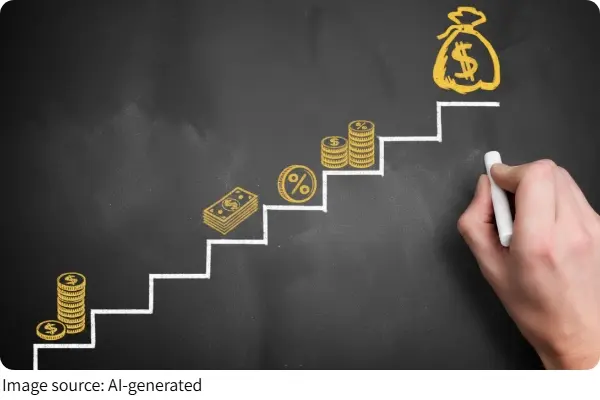
Compounding is one of the few financial principles that operates quietly yet powerfully in the background. It does not demand constant attention, but it does require commitment. The earlier it is activated and the longer it is allowed to run, the more transformative it becomes.